Overview

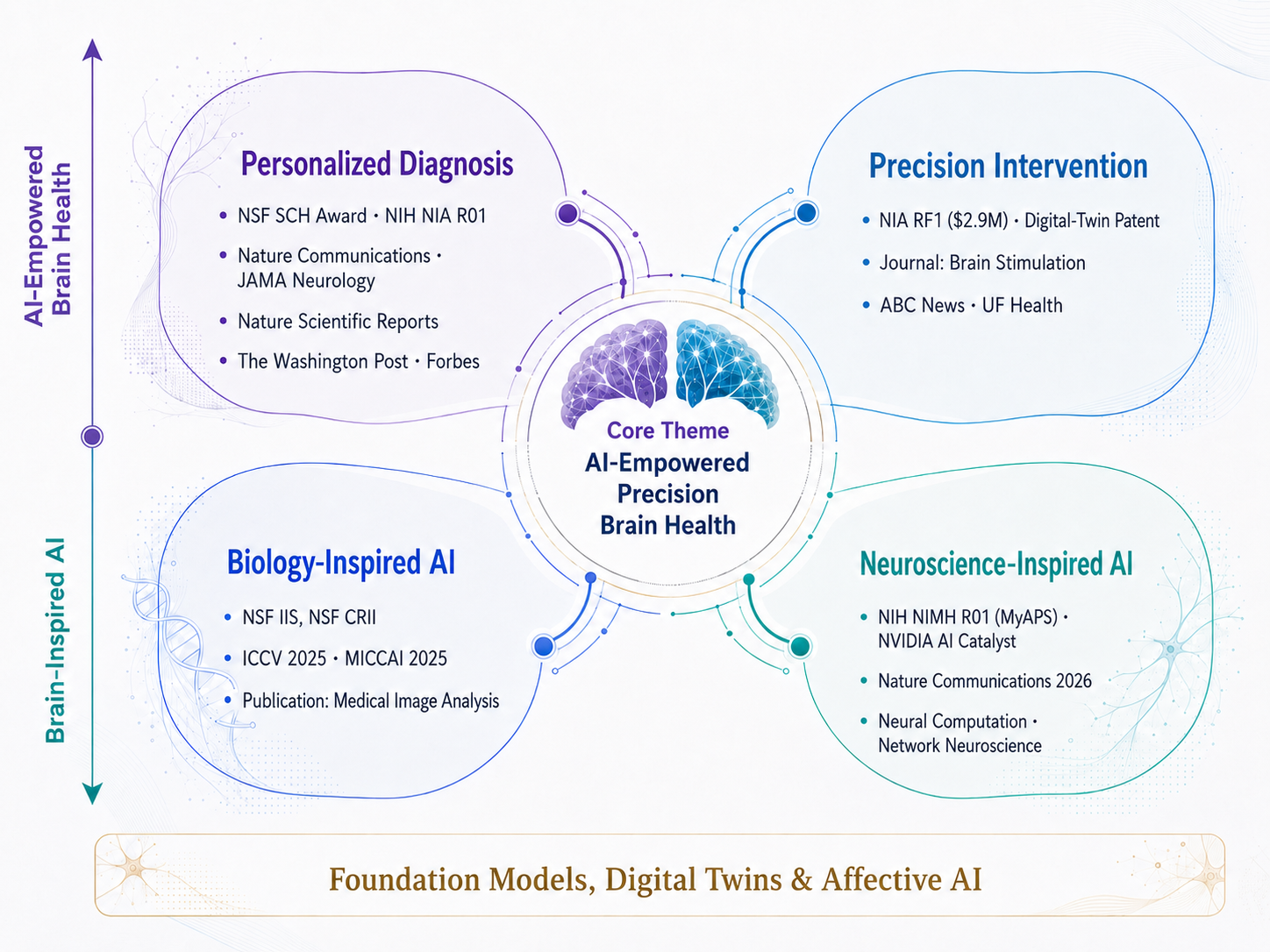
The SMILE Lab's research encompasses two principal themes: AI-Empowered Precision Brain Health and Brain-Inspired AI. We develop novel machine learning and deep learning methods to understand, diagnose, and treat neurological conditions, while simultaneously leveraging principles from neuroscience to design next-generation AI architectures. Our interdisciplinary approach bridges biomedical engineering, computer science, and clinical neuroscience to create translational impact.

Overview diagram of SMILE Lab research themes showing the intersection of AI-empowered brain health and brain-inspired AI

Research Tree

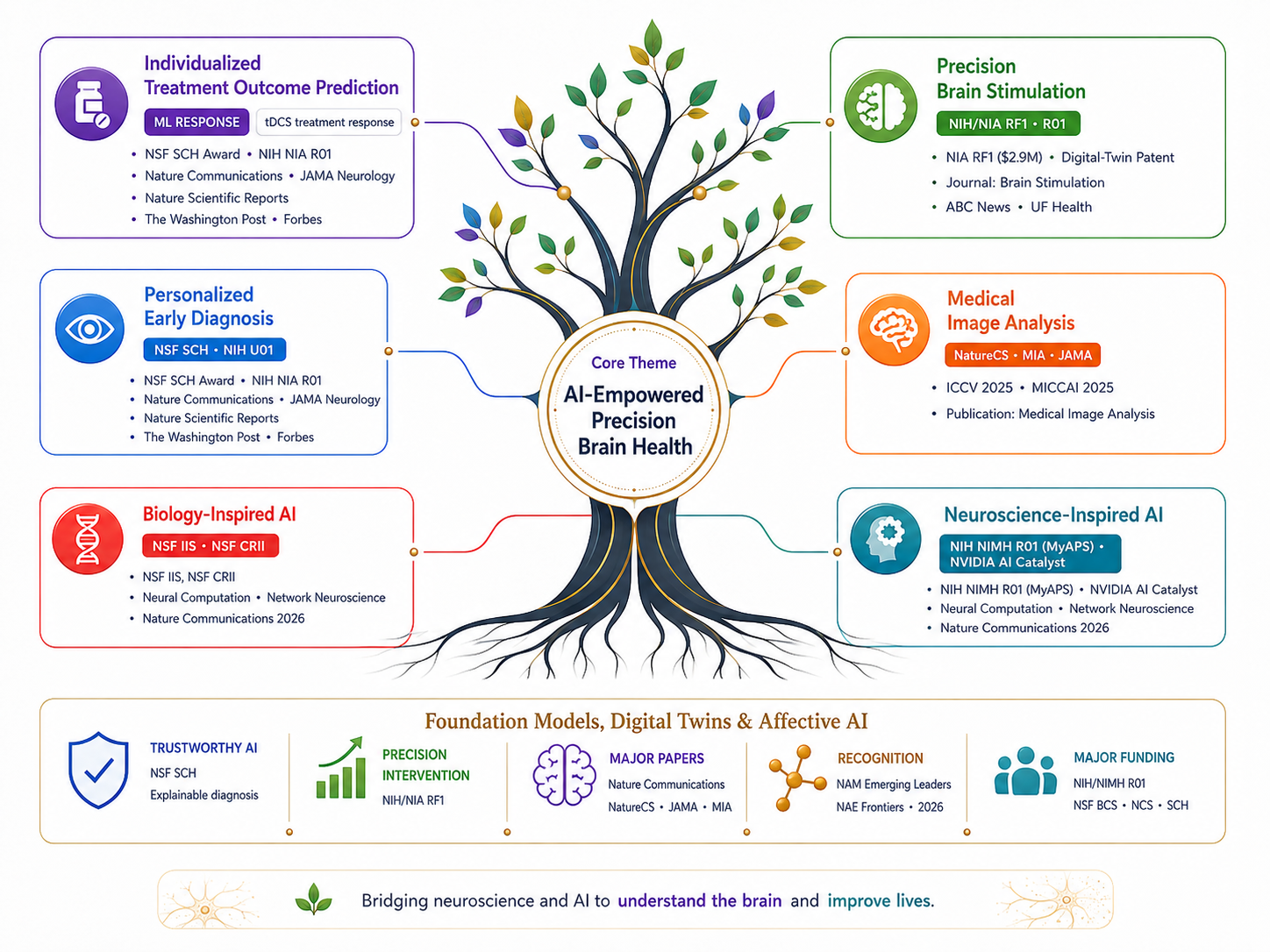
Our research spans multiple interconnected areas, from foundational AI methods to clinical applications. The research tree below illustrates how our projects and expertise areas connect and build upon one another.

Research tree diagram showing the interconnected areas of SMILE Lab research including AI methods, brain health applications, and neuroscience-inspired models

Research Areas

AI-Empowered Brain Health

We develop machine learning models to decode complex brain dynamics from neuroimaging data, enabling early diagnosis and personalized treatment of neurological conditions. Our work includes early Alzheimer's disease diagnosis through retinal imaging biomarkers, predicting personalized treatment outcomes for brain disorders, and designing precision interventions via transcranial direct current stimulation (tDCS). By combining advanced AI with clinical neuroscience, we aim to transform how brain diseases are detected and treated.

Brain-Inspired AI

Drawing from how the human brain processes information, we leverage neuroscience principles such as emotion perception and visual processing to develop next-generation AI architectures. By understanding neural mechanisms underlying cognition, attention, and emotion, we design computational models that are more robust, interpretable, and efficient. This bidirectional approach not only advances AI capabilities but also deepens our understanding of the brain itself.

Deep Learning & Foundation Models

We pioneer the development and application of cutting-edge deep learning techniques for biomedical challenges. Our work includes 3D vision foundation models such as BrainFounder for neuroimaging analysis, generative AI for synthesizing and augmenting medical data, digital twins for patient-specific modeling, and large language models (LLMs) for biomedical text understanding and clinical decision support. These foundation models enable scalable, generalizable solutions across diverse healthcare applications.

Medical Image Analysis

Our lab has deep expertise in medical image analysis spanning CT perfusion imaging, brain segmentation, retinal imaging, domain adaptation, and image super-resolution. We develop algorithms that improve diagnostic accuracy, reduce radiation dose, and enable new clinical workflows. Our research in this area has been published in leading journals including The Lancet Digital Health, JAMA, PNAS, and Nature Computational Science, reflecting the translational impact and clinical relevance of our work.

Funded Projects

NIH NIH

AI Passport for Biomedical Research

R25GM155478

A workforce development initiative funded by the National Institutes of Health to train the next generation of researchers at the intersection of artificial intelligence and biomedical science.

University of Florida UF

AI for Critical Care Hypotension Treatment

DRPD-ROF2023

Learning optimal treatment strategies for hypotension in critical care patients with acute kidney injury using artificial intelligence.

NSF NSF

Brain-Informed Bidirectional Deep Emotion Inference

NCS-FO-2318984

Exploring the intersection of neuroscience and AI for understanding and modeling human emotion through brain-informed goal-oriented inference.

NIH NIH · $2.9M

AI for tDCS in Cognitive Aging

RF1/R01

Developing AI-driven approaches to optimize transcranial direct current stimulation (tDCS) protocols for combating cognitive decline in aging populations.

NIH NIH · $5M

AI Tool for Parkinson's Diagnosis

U01

Building an AI-powered diagnostic tool for early and accurate identification of Parkinson's disease using multimodal neuroimaging data.

NIH NIH NIMH · $2.3M

Attention Biases to Threat

R01

Investigating attention biases to threat using AI and neuroimaging, advancing understanding and treatment of anxiety-related disorders.

NSF NSF · $1.2M

Trustworthy AI for Neurodegenerative Diseases

SCH

Developing trustworthy and interpretable AI systems for diagnosis, monitoring, and treatment of neurodegenerative diseases.

NIH NIH NIAAA · $6.6M

Gut-Brain Axis in HIV

P01

Multi-PI project investigating the gut-brain axis in HIV through AI-powered analysis, leveraging neuroimaging and multi-omics data integration.

Oracle Oracle

Explainable AI for Alzheimer's from Retinal Imaging

Oracle Research Award

Developing explainable AI methods to detect early signs of Alzheimer's disease from retinal imaging, enabling non-invasive screening at scale.

Patents

Systems And Methods For Predicting Perfusion Images From Non-contrast Scans

Ruogu Fang, Garrett Carlton Fullerton, Simon Kato

U.S. Patent No. 18/230,835 · Filed August 7, 2023

System And Methods of Predicting Parkinson's Disease Based on Retinal Images Using Machine Learning

Ruogu Fang, Maximillian Diaz

U.S. Patent No. 18/038,517 · Filed March 24, 2023

System and Method for Precision Dosing For Electrical Stimulation of the Brain

Adam Woods, Aprinda Indahlastari, Alejandro Albizu, Ruogu Fang

U.S. Patent No. 18/018,734 · Filed January 30, 2023

Collaborative Feature Ensembling Adaptation For Domain Adaptation In Unsupervised Optic Disc And Cup Segmentation

Ruogu Fang, Peng Liu

U.S. Patent Application No. 18/007,366 · Filed January 30, 2023

A Machine Learning System And Method For Predicting Alzheimer's Disease Based On Retinal Fundus Images

Ruogu Fang, Jianqiao Tian

U.S. Patent No. 17/928,345 · Filed November 29, 2022

Systems And Methods For Functional Task Prediction Using Dynamic Supervoxel Parcellations

Ruogu Fang, Kyle B. See, Stephen Coombes

PCT/US2022/081801 · Filed December 16, 2022

Systems And Methods For Image Denoising via Adversarial Learning

Ruogu Fang, Peng Liu

PCT/US2021/043635

Multimodal CT Image Super-Resolution Via Transfer Generative Adversarial Network

Ruogu Fang, Yao Xiao

Provisional Patent · Filed March 25, 2020

Neural Network Evolution Using Expedited Genetic Algorithm for Medical Image Denoising

Ruogu Fang, Peng Liu

U.S. Patent Application No. 16/558,779 · Filed September 3, 2019